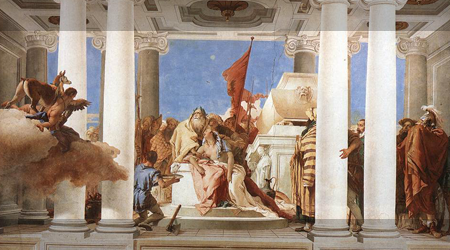
The Sacrifice of Iphigenia

A painting made by Villa Valmarana, Vicenza. The scene is depicts a scene in Greek Mythology.

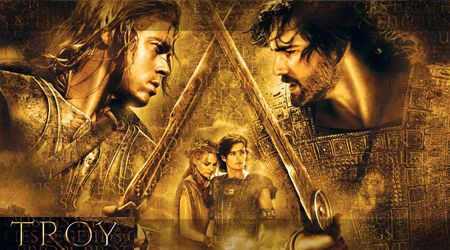
Troy (Movie)

An adaptation of Homer's great epic, the film follows the assault on Troy by the united Greek forces and chronicles the fates of the men involved.

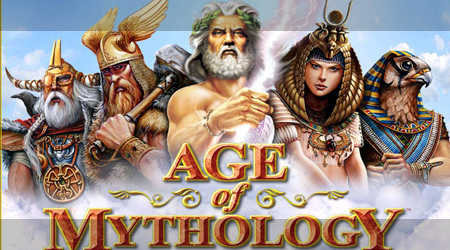
Age of Mythology (PC game)

Age of Mythology takes inspiration from the myths and legends of the Greeks, Egyptians, and Norse, rather than from actual history. Its campaign follows an Atlantean admiral, Arkantos, who is forced to travel through the lands of the game's three cultures, hunting for a cyclops who is in league with Poseidon against Atlantis.

(Bonus) The Epic's Hero

Posted by Ronald Amos On Saturday, October 30, 2010 0 comments

From http://i.tbs.com/


                So today I am to choose a hero from the Iliad. Well, what’s a hero anyway?
Hero is defined as:
1. a man of distinguished courage or ability, admired for his brave deeds and noble qualities.

2. a person who, in the opinion of others, has heroic qualities or has performed a heroic act and is regarded as a model or ideal: He was a local hero when he saved the drowning child.

3. the principal male character in a story, play, film, etc.                                       
Let these definitions be our basis of picking the character that shows heroism the best. 

Let’s start with Achilles. Achilles is one of the main character in the story and is known as the best warrior in the Achaian army. Everyone knows that no one can fight him one on one. So this adds him 2 hero points. Obviously, he is not a model or an ideal. A warrior must fight for his army in any of the circumstances. He only thinks of himself and fights only for his glory. His selfishness makes him less a hero.
               
'Odysseus' From http://www.rml2.nl/
                Next is Odysseus, he is also a main character and is known as the best strategist in the whole world. There is a time in the story that he is surrounded by a lot of Trojans, rather than running away like a coward he faced his enemies and he survived. So he is a model for bravery,  a skillful man and a main protagonist. This makes him a good candidate for heroism.

                Third is Aias the Great, a main character and is known for his muscularity. He once retreated from his attack in order to return to the ships and drive the Trojans away. In his retreat, Trojans are already mobbing him, but he didn’t care for them for he knows that the ships are more important. So here is our second good candidate, Aias.

                Fourth, Menelaus, a main character and is the husband of Helen. Not much details of strength and courage or nobility is known from this guy. Let us drop him from the rolls.

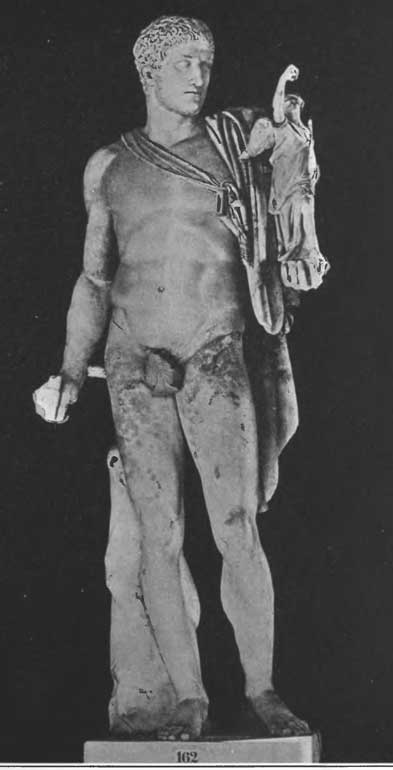
                Fifth is Diomedes, a main character and one of the killing machines of the Achaian army. He is feared by the Trojans for they can see that he holds such brute strength. Some lines suggest that he is wise for his young age. He is another good candidate for heroism.

'Diomedes' from http://www.mlahanas.de/
                Sixth is Paris, a main character and one of the causes of the war. He prioritized his love much than his role as a prince of his country.  He is may be responsible of what he have done, but it is still a flaw in his personality. Only a bit of a chance for Paris…

                Last to be cited is Hector, a main character and the proud leader of the Trojan army. He is a good father and also a good husband. He is patriotic and is ready to die for his country. He is indeed a model for every each of the Trojan soldiers. He knows how to sacrifice and he holds a lot of principles in life. Trojans even consider him as a demigod. He is the most competitive candidate.

                So we are now to choose between, Odysseus, Aias, Diomedes, Paris and Hector. They are all equal, in terms of strength and courage so we will judge them by their contribution to the story. Odysseus is good but only few lines suggest that he shows a good personality. He lacks exposure. Aias is the same as Odysseus, they both lack exposure. Diomedes is a star at the first chapters but is eventually given less roles at the latter part, roles that shows less of his heroism. Paris’ reputation is already shattered by his adultery; this makes him lose my pick. Hector shows a lot of virtues and is present in a lot of chapters in the story even after his death.
               
                And the winner will be… Hector! He is the one that shows heroism at its best. Almost all lines in his role are expressing his heroism. How he decided from his family affairs, how he led the war, how he fought and how the people look at him. All of this pertains to him to be a hero.
'Hector' from http://www.etab.ac-caen.fr/

Let's make some edits!

Posted by Ronald Amos On 3 comments


                So I already finished reading the Iliad and I got bored with the ending. It ended with a funeral, nothing more, nothing less, just one open-ended funeral ending. It’s not that I hate peaceful endings, but I’m just a fan of action and bad-ass movies. I really wanted the ending to be more, epic. And so, the only way to change the ending is to change something in the story. I won’t just change, I’ll also add.


From http://www.davidclaudon.com/
                Remember the time that Hera seduced Zeus and puts him into sleep? This is the point where I will start my editing. Here will how my story will go: “After Hera seduced and put Zeus to a sleep, she left the room to change the tide of the battle. The other Gods eventually know that Zeus is asleep and takes the chance to attack him and dethrone him. Startled by the attack, Zeus wakes up and fights back with the other Gods. From this, a war started at Mount Olympus.  The Achaians and the Trojans keep fighting with each other, even without knowing that their Gods are at chaos. As the Gods become weak as their war passes on, Hades comes up from the underworld and unleashes the final blow that defeats Zeus. Hades throws Zeus to the underworld together with the other Gods. Hades now takes the position of Zeus at Mount Olympus and rules over it. Meanwhile, the war between the Achaians and Trojans still continues but now, without the help of the Gods”.

From http://backseatcuddler.com
                So you might be wondering why I thought this edition. First of all, I hated how the Gods intervened between the fights in war. It’s like they are having cheats on video games, humans becoming too powerful and humans turning into killing machines. But if the story should use my edition, the fights will be much based on showing who has the greater fighters between the two sides. No more Apollo-guided shots , no more Aphrodite-mist abduction, no more killing machine that strikes terror on every foe, no more instantaneous adrenaline rush and no more overpowered humans. The war will show how the two sides create strategies to defeat the other. A more balanced war will it be. And yes, I wish the boring ending could be changed in this way.

Hades became the ruler of the Olympus in my edition, why? Hades is actually 'fairer' than Zeus. Hades is often misconnected as bad, evil and such, but actually he is not like that. Hades has only one child and only one wife. Hades does not have any external or illegitimate affairs with the mortals or souls that dwell in his place, this makes Hades fit to keep the war to be balanced. Hades is not affected by the cries of the sufferers for he only does what he is assigned of, and that is to keep the souls in the Underworld. Anyways, it is really Hades rightful place in Mount Olympus since he is the eldest of the brother, it's just Zeus tricked him and got the worst pick.

So this ends my blogpost, thank you for reading and I hope you can also share to me your editions of Iliad. Happy sembreak everybody!

Patroclus, Patroclus, Patroclus!

Posted by Ronald Amos On Friday, October 15, 2010 1 comments

                As I read the books 12-17 of Illiad, a part of it was about the deeds of Patroclos. In my mind, I was boggled if he is really a noble man or not. But before we analyze that, let me narrate and describe his part in the story.  

Of all the warriors and myrmidons that Achilles knew, only to Patroclos that he is tender and the rest he shows arrogance. Patroclos is the only warrior that Achilles assigned to represent himself in the battlefield. Achilles let Patroclos borrow his armor and even let Patroclos borrow his horses. 

                As Patroclos enters the battlefield, the Achaians’ moral raised. Patroclos managed to push the Trojans far away up unto their walls. Patroclos got a lot of kills, he is like Diomedes with less powers. Patroclos reversed the situation that the Achaians experienced nearby their ships. Sadly, Patroclos got killed by Hector. Yet, his corpse is still an important figure. Hector puts a prize to anyone who could get the body, together with the armor, of Patroclos. So the Achaians got a lot of pressure as the get they carry Patroclos’ corpse. And the story of Illiad goes on …

                The greatness of a warrior is measured by the number of his kills. The glory contributed to the country also adds to the nobility of a warrior. A noble warrior can be said as a warrior that killed a lot or has been a morale booster of the army. Therefore, Patroclos is such a great warrior. Why? His skills are almost at par with Diomedes. As he fights, I noticed that everyone that faces him is sure to die with the exception of Hector. He saved the ships before the Trojans burned them. 

                But wait! It is not only being a noble warrior that you are already totally noble; you must also be a noble comrade. Before Patroclos left for battle, Achilles said something before Patroclos leaves. Achilles said that Patroclos must go back if he already pushed the Trojans far away of the ships. He also said that Patroclos should not grab the chance of stealing the glory away to him by conquering the Troy. Patroclos forgot this advice and pushed even until the walls of Troy. Oh my, he broke the conditions of Achilles! For a warrior to put away the words of a great leader like Achilles is like a blasphemy for some. In Patroclos’ case, it’s like forgetting your best friend’s name. So he is at one point a not noble comrade.

                So is he really noble? Yes he is! Maybe he broke what Achilles has said to him but still his death made Achilles to join the battle. So he appears noble to the army and also to Achilles. To this extent I agree...

So thank you again for reading my blog post and please leave a comment!

Analyze! Character of a man at war

Posted by Ronald Amos On Friday, October 8, 2010 1 comments

             image from http://static.howstuffworks.com
   It is a common quote that war changes a man’s character. Let us analyze this quote and let see if I should agree with this. 

At war, where deceivers, liars, strategists, torturers and bad guys are rampant, the character of a man is challenged. Lives, injuries, fractures are taken away every each minute of war. This situation makes man weak. The power of the tempter grows up and orders him to turn back away to his principles in order to save his life. His mindset focuses instinctively for survival. Do everything for survival even at the cost of losing ones values. Just like what happened to Dolon when he was caught by Diomedes and Odysseus. He splatters out every each detail of the locations of where Hector’s camp is located. 

 image from http://i33.tinypic.com
                 At war, a man usually chooses between two things, his life or his honor. Choose life and his honor will flush down, or choose honor and his will eventually die. Instinctively, usually without the inspiration from others, a man chooses his life and swallows his honor down. But how about when a man has an inspiration and empowerment from others in this kind of situation? 

                A man at war usually fights for the honor of his country, though some fight just for their pleasures. But mostly, warriors that have gone to war are inspired by their king and not by the pleasures that waits for them. By this inspiration man can surpass their fear of death. Just as how determined as Aias as he goes back to their ships. The Trojans are already mobbing him, but he does not mind those Trojans and keep going. Also Odysseus, when the Trojans already gathered around him, not fear but courage and strength arose from him. But yet our best example is Hector. He can escape from the war and leave Troy together with his family. But still, he decided to lead and join the army, for he clings in his honor.  
From google

                So using the two situations, where the first one is uninspired and the second one is empowered and inspired, we can process the quote given. It is therefore agreeable since they both changed the character of a man. But I still do not believe the other side of it, where man degrades his character. 

                Their instincts might be working almost every time, but the warriors are not animals that rely on instincts. Just like those Greeks that were strengthened and converted just because of the war. Their honor steals the spotlight from their instincts making them more determined and empowered than before. They can overcome their fear of death building to them blocks and blocks of additional positive values for their character. 

                To conclude this blogpost, I can say that most of the times, man does not degrade his character in war, but rather the war even strengthens and polishes it through its trials.


Honor, oh sweet Honor

Posted by Ronald Amos On Friday, October 1, 2010 1 comments


Honor can be defined in many ways.

  1.    It can be defined as a good sense of what is right, just, and true.
  2.    It can also be defined as strict conformity to the duty imposed to conscience, position or privilege.
  3.    In some other cases, it is just defined as fame or reputation of the man holding it.
Credits goes to: http://www.brainyquote.com/words/ho/honor174177.html for their definition 

In any angle we look at its definitions, we can say that this attribute of man is considered the basis of a well-respectable man. 

                If we’ll be using this “honor” (word) to be as an adjective for a person, it can be expressed as honorable. To be given this adjective usually depends to the people around you. As said earlier, it is the reputation of the person; therefore, one must have a good reputation before having to be described as “honorable”. 

                As I ravel the pages of a beautiful epic named Illiad, I saw the situation between Menelaos and Paris. Those two quarrels over a woman, named Helen. Menelaos is a very strong Achaian and is the husband of Helen. Paris, who came from Troy, brought Helen to his homeland. A clash between their countries is supposed to happen, but the leaders of their countries decided that the two are the ones that should fight, as a representative of their countries and as a battle of whom Helen should join. 

                Their fight went somehow like this: (not the real fight, but the scenes in the book are close to the movie “Troy”)

 
- From the movie "Troy"


              Just to clear things up, Menelaos did not die and Paris did not ran to his brother’s knees in the book. Going back to the topic, in this fight, we can see that Paris is overwhelmed by the strength of Menelaos. Even Though Paris, escaped from the fight, everyone can conclude that Menelaos is stronger than Paris. 

                Anyways, what does honor relate to those two guys I have said earlier? Well, I just want to compare who is more honorable between the two. So let us analyze this by using our definition of the word “Honor”. Paris carried Helen away from her husband and brought her to Troy. This act of his, made his brother, Hector, be mad at him. Using these two incidents, Paris broke the first rule and the third rule. Paris was wrong in his adultery and through this; his reputation to his brother went down. So it is minus 2 “honor points” for Paris. Menelaos appeared that he won his fight with Paris, so his reputation with his people went up. A good plus 1 “honor point” for Menelaos! Using our “honor points” and the books 1 - 5 as a basis, we can conclude that Menelaos is more honorable than Paris.
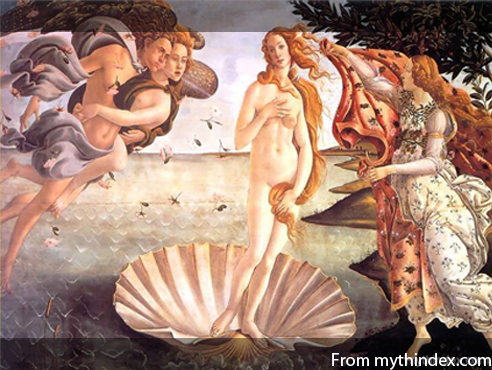

                But wait! Based on the prologue of Illiad, Paris was chosen by the three great greek goddesses, Athena, Hera and Aphrodite to choose of whom of the three is the most beautiful. Paris chooses Aphrodite and as a reward, Aphrodite gives Paris the most beautiful woman in the world and that woman is Helen. So what am I pointing to? The three Godesses chose Paris because he is a man that is noble or good enough to be the judge for their competition, that means Paris holds such great honor.  It is not Paris’ fault if he trusted Aphrodite too much, that he didn’t thought that Helen had a husband. Aphrodite is a goddess, even if I am in Paris’ shoes, I’ll trust the words of a goddess. So using the point of view of a god, Paris is more honorable than Menelaus. Since it is the point of view of a god, Paris is the winner overall.


                Just to add something, I see that the situation of Paris is relatively the same as the situation of our incumbent Chief Justice Renato Corona. Just like Paris, he was appointed by a high ranking person and his reputation got bad due to some conspiracy theories that came out. It is not also Corona’s fault that he was the one that was appointed by the president to be the Chief Justice. Yes, he can reject the offer, but why waste the chance? Anyways, I just wanted to share my idea on this one.

                So as to end this blog post, honor is not totally measured using the physical and visual things that are present in a person, but also his works and his thoughts that are hidden from everyone’s eyes. Thank you for reading this blog post and I hope you’ll still be with me for another of my exciting blog post!